
Is Women’s Sport Undervalued Because It’s Cheap?
There is a familiar but rarely acknowledged pattern in how society treats women’s sport. Because it often doesn’t cost much, we assume it isn’t worth much. This logic, applied to tickets, wages, media rights, even participation fees, creates a damaging loop in which low financial investment is taken as evidence of low value. But what if the real issue isn’t the cost at all, but the assumptions we attach to it?
Women’s sport is more likely to be free to attend, streamed at no cost, or priced far lower than men’s. On the surface, this feels like a good thing. Sport is being made accessible, community centred and family friendly. But under the feel good framing a harder question emerges. Does low or no cost lead audiences, sponsors, and decision-makers to treat women’s sport as less serious?
This mindset is reinforced through language. “Grassroots,” “voluntary,” “amateur,” “accessible”, which are all positive words, yet often quietly translated as “less important.” Very few elite female athletes are paid to compete. Entire leagues, built on passion, skill and commitment, struggle to escape the perception that because they do not charge premium prices or cannot yet afford to, it must mean the product itself has less value.
What gets lost in this narrative is that cost is not a measure of quality.
The women who compete in underfunded or voluntary systems are not doing less. They are doing more with less. Many juggle full-time jobs alongside elite level training. Others self-fund international travel or take unpaid leave to represent their country. The issue isn’t a lack of effort, excellence or ambition. The issue is a system that has historically withheld investment, then used that lack of investment as proof that women’s sport cannot attract audiences or commercial interest.
It becomes a vicious cycle. Low pay means fewer full-time athletes. Fewer full-time athletes can result in less success, lower visibility and diminished media coverage. Reduced visibility is then cited as justification for continued underinvestment. The cycle is not driven by talent gaps - it is driven by economic assumptions.
And yet, when women’s sport is given the platform it deserves, audiences respond immediately. We’ve seen record breaking attendances, global audiences and viral moments of athletic brilliance. These successes did not arise because the athletes suddenly improved, rather they surfaced because the sport was finally treated as worth showing.
We live in a culture that confuses exclusivity with importance. High ticket prices signal prestige. Premium broadcast subscriptions imply quality. Meanwhile, sports that are easy to access, financially or physically, are seen as less consequential. Accessibility should be seen as a strength. Free and low-cost sport allows girls to discover their potential without navigating financial barriers. It allows families to attend matches together. It invites new audiences to engage, to try things out. These are not indicators of lesser value, rather they are the foundation upon which vibrant sporting cultures grow.
This question is particularly relevant in Wales, where women and girls continue to lead, excel and inspire despite systemic undervaluing. From self-funded youth teams representing Wales on the world stage to rowers crossing the Atlantic and athletes training at night after their day jobs, Welsh women show extraordinary dedication for very little cost.
There are remarkable stories of women balancing elite sport with work, study and caring responsibilities for little or no investment. These are not tales of a sector lacking value. They are tales of a sector lacking the structural support it deserves.
So perhaps the real question is not whether women’s sport is undervalued because it is voluntary or low cost. Perhaps the question is why we allow cost to define worth at all.
Women’s sport has always had value. It’s time the structures around it reflected that.
CWS: A Call for Support
Just over a month ago, we held an event to launch our strategy ‘Changing the Game’, in the heart of Welsh democracy in the Senedd. Just months away from one of the potentially biggest elections affecting Wales, we built on our manifesto calls launched a year ahead of that election. Our four calls, and now strategic priorities to 2029 are:
1. Safety. Ensuring women and girls can exercise safely whenever and wherever they want to.
2. Leadership. Seeing more women on sports boards to ensure decisions taken about women and girls are made with them in the room.
3. Facilities. Working towards venues which are fit for purpose for everyone, from hygiene to equal access.
4. Investment. Greater transparency and reporting of funding to create level playing fields.
Cymru Women’s Sport is working to transform the landscape for women and girls in Wales by advocating, connecting, and celebrating women’s sport and is entirely run by volunteers. To continue this work and deliver meaningful, long-term change, we need partners, supporters and champions.
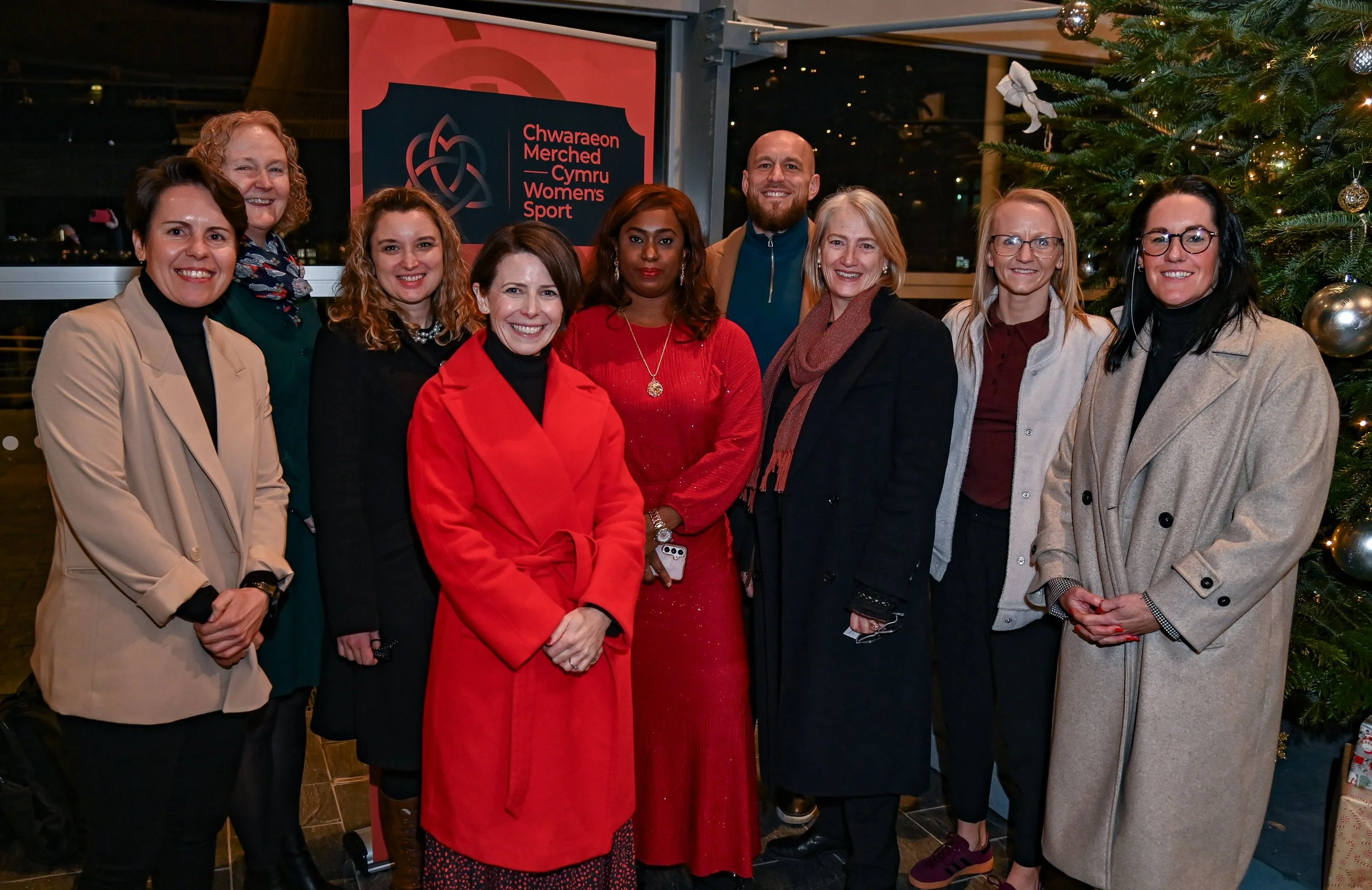
If you believe in the future of women’s sport in Wales, we would love to work with you.
To support or collaborate with CWS, please contact:
👉 contact@cymruwomensport.org
Let’s change the game, together