Whisper Cymru & Cymru Broadcast Centre
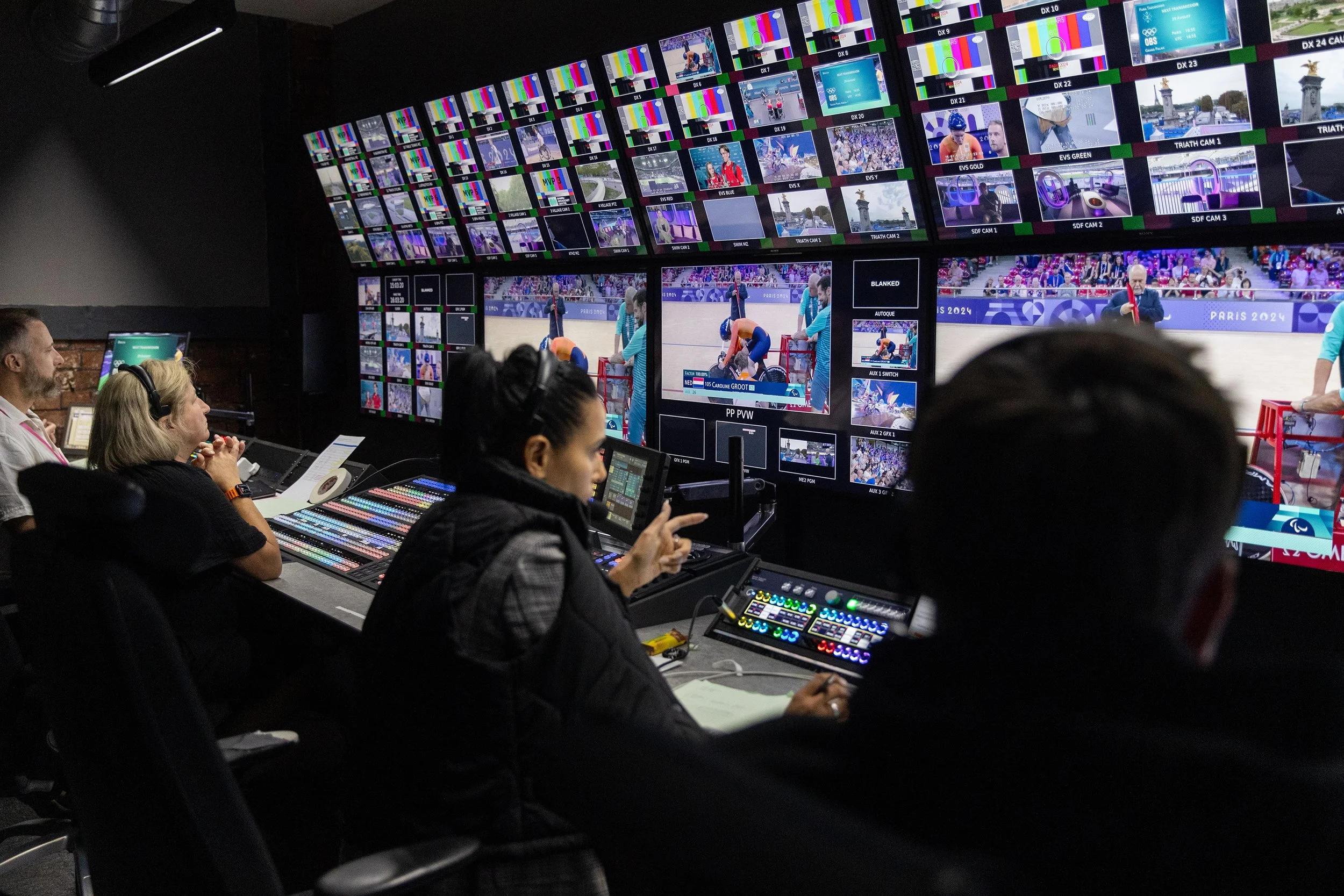
The 2024 Paralympics being broadcast live from the Cymru Broadcast Centre
Did you know that the 2024 Paris Paralympics were broadcast from Tramshed Tech in Cardiff? Carys Owens, the Managing Director of Whisper Cymru has led the start-up of one of the foremost sports broadcasting companies in the UK, which has been championing and leading the way on the airing of women’s sport across national and international platforms. Their production of the Women’s Euros in 2022 won them and the BBC a BAFTA.
It may seem strange to know that the Women’s Rugby World Cup, while fronted by Gabby Logan and Ugo Monye in the stadiums, was being broadcast right out of a remote production facility in Cardiff. But what Whisper Cymru has championed is women’s sport and propelled it into mainstream arenas where now they are being out-bid by bigger companies who are finally taking notice of things such as the Women’s Super League (WSL). But Whisper were at the forefront of trying to ensure women’s sport was given a platform long before the big sponsors recognised women’s sports’ potential.
Carys says, “We’ve been producing the Women’s 6 Nations for ten years when it was a smaller scale highlights show, to now covering the competition live on BBC One and Two with multiple cameras, experienced well-known presentation, punditry and commentary. That is down to the commitment of the BBC to invest in the production side to give it the same care and attention as the Men’s game. Working on the Women’s Rugby World Cup meant so much, to see where interest in the sport has got to now, not just in participation and ticket sales, but in traditional linear viewing figures and digital engagement.” These contracts do run on a tender basis with broadcasters, and whilst Whisper know that contracts such as WSL and Women’s 6 Nations are one of the most competitive processes in sport production, we are hugely proud to see that companies are now levelling up their ambition, respect and care that it deserves when pitching for Women’s sport productions.
The Cymru Broadcasting Centre in Tramshed Tech where Whisper Cymru operates out of was built with accessibility in mind ahead of the 2024 Paralympics, meeting the ambitions of Channel 4 and the other stakeholders. Whisper Cymru worked closely with Channel 4 to produce the competition, where 32% of the production team were disabled staff. But while the set up for that project created the opportunity for people who might otherwise not have had an opportunity to work on live sport, ensuring a pipeline of production talent is essential. The Whisper Academy is attempting to deal with these skills gaps and ensure the next generation of Welsh Production talent can have work in an inclusive and diverse workplace, being in Wales is just the icing on the cake.
And as Carys says, “you wouldn’t expect only men to be working on men’s sport, and you wouldn’t expect someone with a disability to be working on only para-sport.” The need to develop fresh talent from all walks of life to ensure diverse representation on some of the top sporting programmes on our screens is key. And for Jess, Carys’ talented Senior Production Coordinator at the Cymru Broadcast Centre, the diversity of thought that comes with having women in the production team is essential. They’ve both observed that having women being part of the editorial decisions generated different outcomes. Carys and Jess aren’t sure if it’s more empathy that the women bring, but the different experiences which ensure that the content is more relevant and able to reach more people is what naturally comes from having diverse perspectives working on the job.
As women’s sport continues to rise and more eyes are on it, these perspectives are also what’s helping professionalise the coverage. Carys says it is vital to have male allies on the production floor, but it has also been a journey to help people feel comfortable with making criticism of women’s sport as much as it would be expected of men’s. “If a team has investment, a formal coaching squad and everything, then editorially we should be comfortable with saying a team should be doing better than they are. And at first it was that men on the production floor didn’t feel comfortable with calling this out, almost like, ‘who is he to be saying they’re not good enough?’” Steadily though, as coverage of women’s sport has become a more regular thing, the same rigorous editorial content has become the norm in broadcasting women’s sport, as it has in men’s. It’s what audiences expect.
Carys reflects though that that has brought challenges for female players. There have been high profile moments in women’s sport over recent years where women’s teams haven’t had the same infrastructure as even their counterparts across the border in England. The Red Roses and the Lionesses’ successes in England have at large part been about investment decisions, and this goes right through to the support team around them.
Carys also talks about how the press relations team around men’s teams will be rigorous in ensuring that the right perception of their players is maintained and right now, it is something that is only just being developed for women’s teams in Wales. At the same time, many female athletes are finding their power and growing their individual worth through social media. Many of those competing with Team GB in 2024 built their profile individually, with 69% of the content which put out about the games being from female athletes.
But this is now rubbing up against the growth of the game through traditional means, as audiences demand more professionalism from the athletes, sponsors look to get on the front of shirts, and more attention is paid to the actions of the players on and off the field. Chloe Kelly’s ‘f’ bombs as the Lionesses celebrated their Euros win, and Jaz Joyce’s Tik Tok dance in the 6 nations highlighted how far the games have changed through this huge new focus being paid to them. Chloe Kelly took to social media to apologise, whilst Jaz wrote a Guardian column about the experience of her haters on social media.
But of course, Carys says, women’s sport is reaping the benefits of free to air as more and more men’s sport goes behind a paywall. “Now we’re seeing more men just watching ‘because it is on’ and having an opinion on different players like never before. And dads and daughters, dads and their sons in the crowds at the Women’s Rugby World Cup. It’s been a game-changer in keeping women’s sport free-to-air”.
With such an amazing record of stepping into unchartered territory, building up the WSL, the Euros and the Rugby World Cup and then leaving them in a far better place than they started, what is next for Whisper Cymru?
“Formula One obviously continues with us, Super Rugby Cymru continues, and we’ve just won the contract with Channel 4 for the Winter Paras and the 6 Nations coverage for S4C. We also will be working on the first ever Women’s British and Irish Lions Tour in 2027, which feels like a full circle for our production team…from 6 Nations, to the WRWC and then the Best of the Best coming together for the Lions.”
The 2025 summer of women’s sport has in many ways been years in the making by many different sectors, types of professionals, athletes and national governing bodies, but Jess remarks that the effect has been huge, and even in Whisper Cymru’s own office. Two of the women working there have joined women’s football teams, alongside herself, playing for Caerau Ely, just because of watching the Euros this summer.
With this incredible facility on our doorstep, and some of the greatest moments of sporting history coming to our TV screens from the Cymru Broadcasting Centre and the unstoppable rise in women’s sport, it’s hard not to feel excited about the future that Whisper have helped to create.
As this article goes to publish, we hear that the Women’s World Cup coverage won the Editor’s Choice Award in the Broadcast Sports Awards, and they are also on the shortlist for the main Broadcast Awards, which just shows how women’s sport is changing the face of broadcasting!